
Before your next therapy session, read this
Guest post by Chelsea Kells, creator of Color Mending®
The skill most of us were never taught
In the mid-2000s, Brené Brown and her team surveyed more than 7,000 people and asked them to list every emotion they could recognize and name as they were experiencing it.
The average answer was three: happy, sad, and angry.¹
I’ve spent the last six years asking people a slightly different question: “How would you describe your relationship with your emotions?” And the answers tell me that not much has changed since Brené Brown’s research.
About 70% of the people I surveyed describe their relationship with their emotions as confusing, distant, overwhelming, or something they’d rather avoid altogether.
This matters because emotional regulation (the thing therapy is often trying to help you build) requires a skill that most of us were never explicitly taught: the ability to identify what emotion you’re actually feeling in your body.
Dr. Lisa Feldman Barrett, a Northeastern University psychologist and neuroscientist behind the Theory of Constructed Emotions, calls this skill emotional graunularity. Research involving Barrett and her colleagues has found that people with this skill are less likely to resort to unhealthy coping behaviors like binge drinking or aggression when under stress,² and are more psychologically resilient overall.³
Without emotional granularity, you’re navigating in the dark.
With emotional granularity, your emotions start feeling like information, or clues, you can decide what to do with
How coloring changed what I thought I knew
When I noticed this gap in my own meditation clients, I started looking for ways to teach this skill that didn’t feel clinical or intimidating.
After a lot of experimentation, I landed on something unexpected: coloring.
Not as art therapy. Not as a relaxation technique. But, as a body-based tool for reading your own emotional state.
Here’s how it works:
- You choose a topic you want to understand better — a relationship, a decision, something you keep avoiding
- You do a body scan — while thinking about what you selected in step 1, you check in with your body to see which part is making the most noise (or where you feel the strongest sensation)
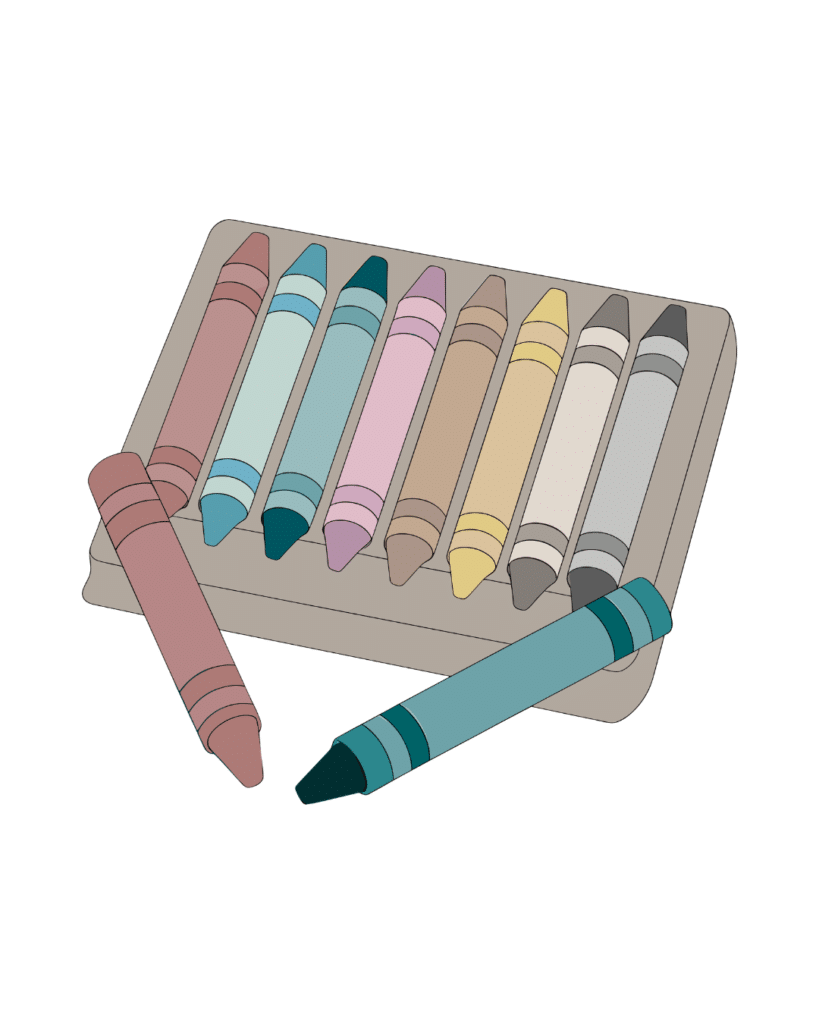
- You then color out the noise your found on a piece of paper — using any shape and color you want, no artistic skills required. This technique is called intuitive coloring.
After repeating these steps with more than 300 people across all different backgrounds and life experiences, I started tracking consistent patterns.
Colors represent emotion states. Shapes represent what the emotion was about.
I compiled these findings into two charts, the Color Chart, and the Common Shapes Chart. As I presented this information to the people I was coloring with, they began connecting dots they hadn’t considered before, and would leave their coloring session with with clear insights that came from their own bodies.
And, Color Mending® was born.

What this has to do with your therapy sessions
Last week I colored with a woman who was struggling to let go, particularly around using food and marijuana to self-soothe, and she wanted to understand why.
Her coloring helped her see the resistance she was feeling about making changes in her life was rooted in her relationship to the emotion disappointment. She left our session together not with a vague sense that something was wrong, but with a specific topic she could explore with her therapist.
That’s the difference.
When you can name what you’re feeling and understand what it’s pointing to, your therapist can spend your session time together on the real work. For example: building skills, shifting patterns, making meaning — instead of starting from scratch every session, trying to figure out where to begin.
Color Mending: Learning emotions through coloring
If you want to explore if Color Mending would be a helpful tool for you, I made a free guide called Emotions are clues, not rules. It’s a great starting point for anyone who wants to understand the importance of reading and naming their own emotional signals.
And, if you want to hear more, Elizabeth Harwood, LCSW, and I talked through 6 common myths about therapy on my podcast Nerding out on emotions. It’s worth a listen whether you’re brand new to therapy or have been in therapy for awhile.
Chelsea Kells is the creator of Color Mending®, a neuroscience-based tool that helps you decode your emotions through coloring. She works with individuals in 1:1 and group settings, and trains therapists, counselors, and coaches to use Color Mending with their clients. You can learn more at colormending.com.
Footnotes
¹ Brené Brown, Atlas of the Heart (Random House, 2021), p. xx-xxi.
² Tugade, Michele M., Barbara L. Fredrickson, and Lisa Feldman Barrett. “Psychological Resilience and Positive Emotional Granularity: Examining the Benefits of Positive Emotions on Coping and Health.” Journal of Personality, 72, no. 6 (2004): 1161–1190.
³ Kashdan, Todd B., Lisa Feldman Barrett, and Patrick E. McKnight. “Unpacking Emotion Differentiation: Transforming Unpleasant Experience by Perceiving Distinctions in Negativity.” Current Directions in Psychological Science, 24, no. 1 (2015): 10–16.
We’re psychotherapists in Weschester, NY.
Visit our homepage at: www.couragepsych.com